
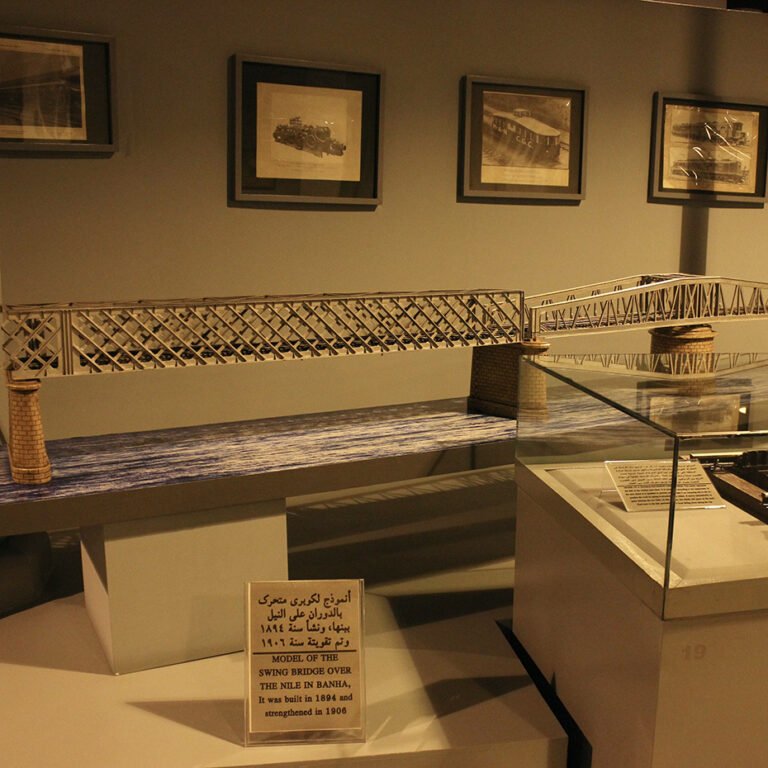
But what are the basic rules that the expert engineers overlooked? Perhaps the first and most important rule is the flood and the rise of the Nile level that covers agricultural lands at certain times of the year. this rule simply meant that railway tracks must not only be built on ground level, but higher than the Nile flood level so that the water doesn’t submerge the tracks. This self-evident knowledge was absent from the British engineers in building the bridges in the Delta, and this is what the chief engineer “Henry Swinburne” discovered by chance in August 1852 when the Nile waters submerged a bridge under construction over one of the canals in the Delta, and the tracks would have been destroyed if they had been installed, but fortunately, the construction was not completed at the time. “Henry Swinburne” ordered the heightening of the bridge above the Nile level during the flood so the train could cross it all year round, not just in the months of the Nile’s recession.
This example of ignoring basic rules was not an exception in a small bridge, but a practice that continued even in building a huge bridge like the Benha Bridge. When they began taking the necessary measurements for this bridge, Henry Swinburne and his assistant decided to conduct a survey of the ground surface in that area in February 1853, but a severe storm blew up and delayed this process, affecting the progress of work and the set schedules. This storm was not a matter of bad luck or just a passing event; these were expected winds known to all Egyptian farmers, sailors, and geographers at that time of year. The British chief engineer’s lack of knowledge of these seasonal winds, whether due to their ignorance or because they did not rely on Egyptian engineers, was a cause for delay and additional costs—something no company in England would have tolerated—but in Egypt, this delay was the primary way to achieve profit.
In another example from the Benha Bridge, this systematic ignorance of environmental conditions and nature caused another tragedy, when the British engineers decided to build the bridge foundations in the harvest months, specifically in June 1853. This decision was built on the calculation that they would finish the foundations before the Nile flood, and this was an absolute necessity for them, so they worked with all their effort to place the foundations in the Nile while it was at its low state. What they didn’t account for was that the workers working on the project were the same farmers who were busy at that time of year harvesting their crops or working in the fields of the Pashas, foremost among them the Khedive, and calling them to build the bridge at that time could cause the destruction of crops and disruption of the agricultural cycle, which the Khedive would not allow. Therefore, when the flood came that year and the foundations were not completed, the bridge bases were destroyed, and they had to rebuild them in the flood recession season the following year. This destruction and rebuilding, in addition to the delay, were reasons for exorbitant costs that were not accounted for at the time the concession contract was signed.
This ignoring of basic rules in construction in Egypt was a cause for a larger confrontation, not just with nature and the Nile, but also with the landowners themselves. The British engineers did not understand the resentment of the landowners and their fear of confiscating their lands without compensation in favor of the railway project. As a result of the absence of a private property law in that period, it was not logical for the government to issue a law regulating the seizure of land and compensating people as there was in Europe. So the paths for the train passed through farmers’ lands without a clear plan to compensate them. This point, which was absent from the calculations of technical engineers, caused them many problems during the construction of the bridge and in other places. The engineers relied on wooden poles and other tools stuck in the ground to define the distances and the path for the train. The farmers decided to change the locations of these wooden poles or steal them as a way to avoid the train passing through their lands, and consequently, this caused a distortion in the measurement process and they needed to repeat it several times. It wasn’t just the farmers in the bridge area who were the cause of this delay, but also the farmers themselves who were working in the construction of the bridge.
Even with the availability of hands after the harvest, the working conditions in building the bridge were enough to make the farmers escape, and this affected the progress of work on the project, because they were required to work in the absence of any consideration for their needs, whether shelter or food or others. In the same month that Henry was doing this survey, he received news from one of his engineers that 100 pounds had been stolen from his tent plus 9 miles of iron. These thefts were common among the workers as a way to compensate them for the difficult working conditions and the suffering they went through; as for their other means of resistance, it was escape. Over time, farmers escaping from work in railway projects became a widespread, semi-organized phenomenon, even before the labor movement in its known sense was established at the end of the 19th century. This made the British seek the help of the Khedive to provide a force to guard the farmers and limit their movement, but this also brought no result.
References:
Unpublished PhD dissertation – Engineering Profit: Egyptian Railroads and the Unmaking of Prosperity 1847-1907, Rana Baker