
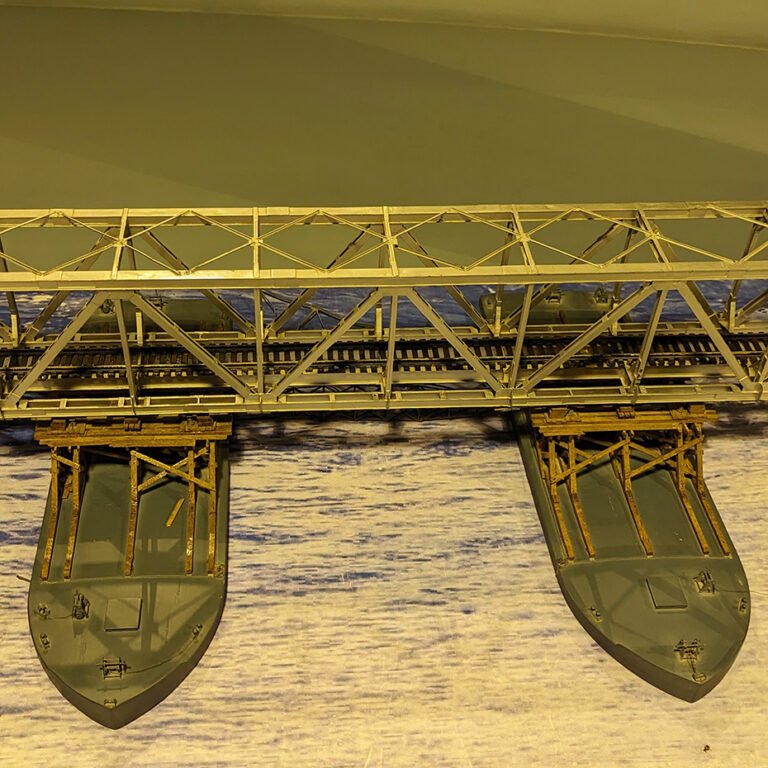
The bridges that trains pass over now might seem like something self-evident in any city on the Nile like Damietta, Mansoura, or Cairo, but this number of bridges was the result of a long journey of trial and error that began with an important accident that changed Egypt’s history, and the railway and its trains were its stage.
In May 1858, while returning from a royal dinner with the Khedive, the crown prince at the time, Ahmed Refaat Pasha, and his brother Halim Pasha were returning by train from Alexandria. At that time, the train needed to cross the Nile in the Kafr El-Zayat area on a Nile ferry, as bridges were not the first choice for the engineer Stephenson because he saw them as “exorbitantly expensive,” so they were replaced by the ferry.
Stephenson expected that the ferry would not need more than 6 minutes to cross the Nile, and would also need a simple physical effort and operation from the workers. But after the ferry operated, it turned out that it took more than two hours for the entire train to cross, and it needed a terrible effort and precise coordination between all the workers to load the train onto it; in fact, it was necessary to evacuate the train of passengers to preserve their lives. But on that night, in Ramadan 1858, fate had another opinion. As usual, the princes were asked to get off the train until the workers loaded it onto the ferry, but the two princes refused and preferred to stay to rest. At that time, the required coordination between the workers did not happen, so the carriage surged with force before they loaded it onto the ferry, and it fell into the Nile waters. In this accident, the crown prince drowned, and his brother, the half-brother of Ismail, became the crown prince and then the Khedive, and this changed the shape of the railway and all of Egypt.
The British used this accident to prove that Egyptian workers were like animals in their muscular strength, but they couldn’t deal with complex technical matters like workers in Europe. In their talk, the British not only ignored hundreds of times the Egyptian workers succeeded in operating the ferry before this accident, but they also ignored the primary reason, which was that they didn’t build a bridge from the beginning in that place to save the money stipulated in the concession contract. Also, the incorrect estimates for the ferry’s operation time and ease of operation were not a subject of criticism by the British. In the end, this accident was the beginning of a new phase: building railway bridges on the various branches of the Nile, but it was also a continuation of the British way of managing the project and making profits through it by any means possible.
In Britain and Europe in general, engineers presented themselves as experts aware of all the circumstances surrounding their project, capable of building railways that endure time, at specific times and without delay, and from here they were able to get funding from banks and make profits from consumers. But in Egypt, the situation was the opposite; building railway bridges, including the Benha Bridge, showed that the British engineers, led by Robert Stephenson, either were ignorant of or ignored basic rules related to construction (like private property, the flood, harvest seasons, and climate conditions in Egypt) as a way to achieve a profit not stipulated in the project contract. The deliberate ignorance or ignoring of these rules was the cause of many problems, delays, and the destruction of existing buildings, and this made bridge construction a very expensive project for Egypt, but a very profitable one for the British company and contractor.
References:
- On Time: Technology and Temporality in Modern Egypt
- Unpublished PhD dissertation – Engineering Profit: Egyptian Railroads and the Unmaking of Prosperity 1847-1907, by Rana Baker