
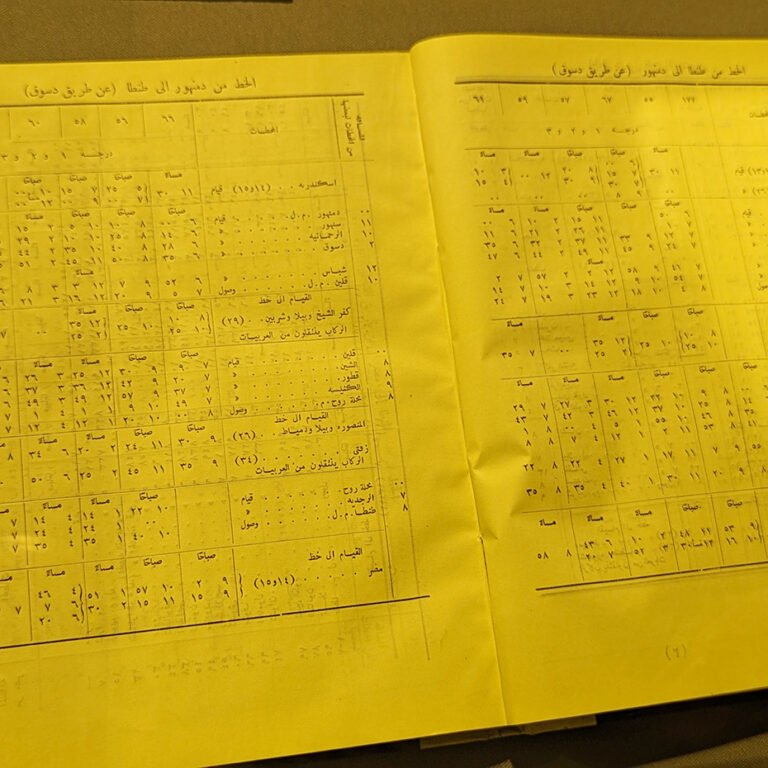
The schedule before us for railway trains and their timings seems like a self-evident and logical thing in all means of transport in the world, but this was not the case for more than a quarter of a century from the beginning of the railway. Despite its humble beginning in the middle of the 19th century in Egypt, the number of trains increased at least three times in the 1860s when it began to appear that the Suez Canal would operate soon and replace the foreigners and British—the train’s most important customers. The result of this was the spread of the train in Egypt, especially the Delta, and by the mid-1870s, it reached 240 locomotives, 60 companies, and 4,000 carriages running on this nascent network.
The basic problem was that there were no fixed schedules or a system for all these trains. That is, the Egyptian railway did not catch up with the other railways in Europe and America that had fixed schedules since the 1850s approximately, or Britain, which had train schedules between Manchester and Liverpool in the 1830s made by Stephenson himself. The logic in train movement was the passenger and his hierarchy. For example, from the beginning, the railway gave priority to the British going to India through Egypt; therefore, the train always waited for the arrival of the “P&O” company steamship in Alexandria and for its passengers to disembark and prepare for departure. Because of this, the train would set off on two trips a week from Alexandria to Cairo according to the ship’s timing, so farmers were forced to wait for hours at their stations in the Delta with their crops, even if the waiting spoiled them. As a result of this priority, there was nothing for the farmers but third-class carriages, even if they were able to buy more expensive tickets. In a higher rank than the farmers and Europeans were the Khedive’s carriage and the nobles’ carriages, as we said. The train would sometimes stop in the countryside so that the notables could board directly from their estates and fiefs. The lack of a system was a reason for disapproval from Europeans and proof for them of the corruption of rule in Egypt; yet, when European consuls arrived in Alexandria, they insisted on their priority in boarding the train to Cairo, even if this made the train return from the middle of the trip for them to board.
The change in this system began for economic reasons like coal, and cultural and political reasons, most importantly the arrival of Ali Mubarak as head of the Railway Authority. Ali Mubarak and Khedive Ismail were colleagues in Paris during their mission there, and they became acquainted together with modern time, clocks, and timetables. Therefore, this engineer was one of Ismail’s most important men in implementing his dream to make Egypt a piece of Europe. So this engineer became primarily responsible for education, railways, and urban planning. In these responsibilities, he followed the principles of modernity, most importantly “Franj” (Western) time and its twenty-four hours starting at midnight, unlike Islamic time where the day starts at sunset. This “Franj” timing became the basis for dividing work shifts, journey times, and even punishments in prisons. Ali Mubarak was very interested in introducing the modern time system to schools and the railway. So he printed the first train schedule in 1870 between Cairo and Alexandria, and then printed a schedule for all trains in 1877. These schedules were printed in the “Wadi al-Nil” newspaper, which was the only private newspaper in Egypt at the time. We can say that Ali Mubarak and the railway system were one of the most important reasons for the spread of “Franj” timing in Egypt and its common use until it became the primary reference. But the most important reason for setting this schedule was not culture or fascination with European modernity and its efficiency alone; it was for a much simpler reason: coal.
References:
On Time: Technology and Temporality in Modern Egypt