
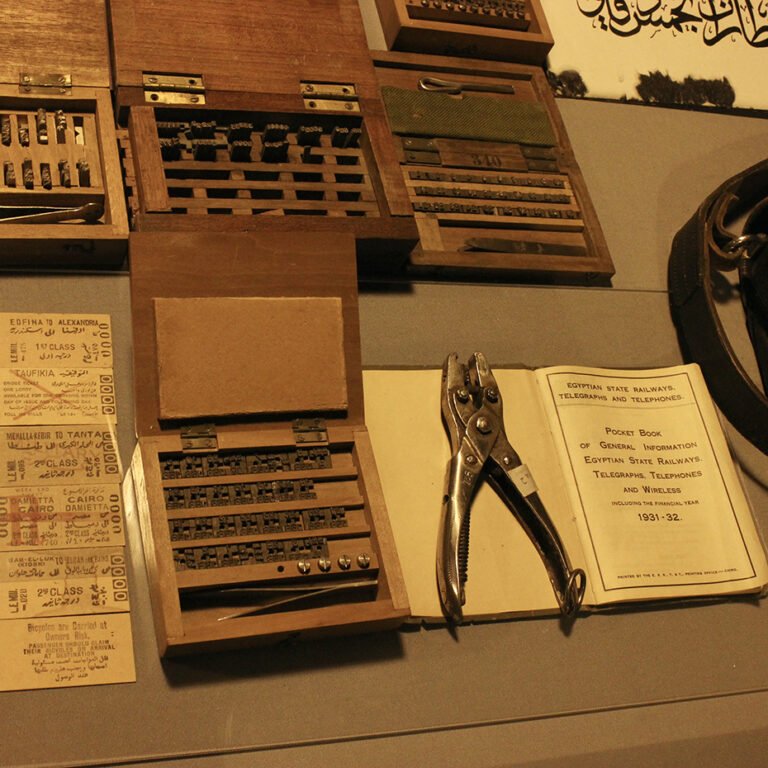
From the beginning, work and workers in the railway were a complex matter, ruled by many conflicts and questions of power and resistance. Right from the start, during the construction of the railway and its extension on Egyptian land, the project required a large number of workers. This was followed by a massive need for labor either to operate the trains, maintain them, or even manufacture them in workshops and sheds. This technology created a large and important space in the relationship of workers with machines from the middle of the 19th century until now.
Although there is no embodiment of these workers’ stories in the museum, they remain present in different forms, such as work tools and the workers we see in the museum window before us. But to understand the original story and the long relationship of workers with their trains and workshops, we must go back to the starting moment and the signing of the contract. Although the Ottoman Sultan stipulated the prevention of “Sukhra” (forced labor) to approve the railway project, Khedive Abbas pledged to provide the necessary workers to build the project.
These workers were farmers from the Delta pulled by forced labor from their lands to pave the roads, lay bridge foundations, and fix the railway lines. In the early 1850s, these workers worked for almost no pay and in difficult conditions. On one occasion in February 1853, 600 farmers were sent to build a bridge near Al-Dalgamun in Beheira, but they weren’t even supplied with a pickaxe or a basket to carry out the digging work! Even when the authority provided them with the necessary tools, the farmers—after a long and grueling workday—would spend the night in the open without any tents or covers to protect them from the cold.
These harsh conditions, and the fact that they were forcibly removed from their land and children without pay, caused large numbers of workers to escape. Escapes happened individually or collectively, to the point that officials suspected there was an organized movement behind this rebellion and act of resistance! What made the situation worse for the British officials was that the farmers, as a result of oppression and lack of compensation, began to take their rights themselves, so many thefts spread—whether it was stealing iron, measuring tools, or even stealing money from the tents of British officials!
All of this made the British ask the government to appoint guards to prevent workers from escaping and stealing. But even this step failed due to the lack of order among the “Ghaffars” (guards) and the failure to pay them appropriate salaries. This situation continued the same way, at least until the Cairo-Alexandria line was built. After that, the weight of labor and their rebellion moved from the Delta to the heart of Cairo, specifically to the Bab al-Hadid station and the Bulaq sheds, which became the most important capital for railway workers in Egypt.
The Bulaq and Cairo sheds, and Jabal al-Zaytun in Gabbari in Alexandria, became the headquarters for all operations related to the railway since its operation in the 1850s. Over time, Egypt’s railways became the largest employer of labor, with the number of workers reaching 15,000 during World War I. The experience of this huge number of workers was fundamentally in the crafts and workshops scattered in cities, especially Cairo.
Over time, and as a result of the financial crisis Egypt faced due to debts, the sheds played an important and pivotal role. They became responsible for maintaining all operating carriages and modifying them to suit the Egyptian environment. In addition to this, the sheds became responsible for producing new carriages using old ones. For example, in the early 1880s, more than 25,000 quintals of iron were cast in the Bulaq foundries and reshaped to manufacture railway carriage supplies, telegraph batteries, and more.
The matter evolved to manufacturing third-class carriages by rehabilitating first and second-class carriages and making their coal consumption lower. Recycling and using all available materials required high skill and creativity from the workers to implement these operations, and it saved thousands of pounds for the railway. But unfortunately, no one recognized this skill or gave financial appreciation for all this effort.
The conditions of workers in the railway and sheds, especially at the end of the 19th century and the beginning of the 20th century, are considered tragic. Daily working hours ranged from 10 to 15 hours, seven days a week without a holiday, and the work—whether in the sheds or on the trains themselves—was very exhausting and dangerous, and with all this, salaries were low.
In Egypt during this period, skilled labor (mostly European) could take 30 piasters a day (about 10 pounds a month). As for skilled Egyptian labor (no matter their experience, like tram drivers or shed workers), their daily wage was about 15 piasters (about 4.5 pounds a month), and that’s if they received their full pay at all! Even the idea of being paid monthly was a privilege obtained by European workers and only a quarter of Egyptian workers in the railway. As for the rest of the workers, numbering 15,000 at the beginning of the 20th century, they worked by the day or the piece, without fixed contracts or even pensions after years of work.
Although the railway was one of the first places where wages changed from “buying the task” to “buying time,” Egyptian workers continued to be paid by the day or the piece until 1923.
From the first moment, Europeans (especially the British) were the managers, supervisors, and drivers of important lines in the railway. Both Khedive Said and Ismail tried to increase the number of Egyptians (especially drivers), but the British management resisted the matter greatly. After the occupation in 1882, the situation got worse because Egyptians witnessed the appointment of more Europeans in the late 19th century until World War I. For example, the number of permanent workers in the railway doubled from 1896 to 1909, while the number of Europeans quadrupled in the same period!
Europeans (led by the British) occupied the most important positions like station masters and supervisors. Even if an Egyptian and a European worked in the same job, the European received several times the Egyptian’s pay. Iskandar Pasha Fahmi, who was one of the railway managers, says that his British subordinates were taking 7,000 piasters a month, while he was taking about a third of that amount!
Aside from the difference in salaries and promotions, Europeans were dealt with through a mixture of incentives and penalties to ensure they committed. For example, if a penalty was imposed on European drivers and deducted from their salary, these deductions were collected and distributed to the most efficient drivers. In addition to that, Europeans were placed on a career path with fixed contracts, promotions, and increasing salaries to encourage them to commit, innovate, and improve the level of work in the railway. But this scenario was not offered at all in the case of Egyptians.
British officials saw Egyptian workers like robots suitable only for performing tasks, but not for thinking and making decisions, and certainly not for initiative or innovation. This racist perception put Egyptian workers in the category of resources, like coal, and the basic way to control them was penalties and deductions from their already weak salaries. What made the situation unbearable was that the only authority that could impose penalties on them was in the hands of European managers and supervisors. This was one of the most important reasons that led to a labor movement in the railway sheds and stations at the beginning of the 20th century.
In the railway workshops and sheds in Bulaq, Egyptian workers lived the details of foreign occupation and its dominance daily. These workers and their labor consciousness did not yet distinguish between workers’ relationships with the owners of small workshops and the fact that they were now living an industrial life as an army of workers under one roof, controlled by a hierarchical system governed primarily by foreigners.
But with time and circumstances, this consciousness began to form slowly; starting from workdays of 12 hours, reaching 21 hours in some stations, and the fact of the absence of any kind of security, monthly salaries, and pensions. What made matters worse was that in the early 20th century, British engineers (led by one named “Pickett”) were persecuting workers in a very humiliating way; every 5-minute delay was punished with a deduction of half a day from the already weak salary!
The matter reached the point where this engineer installed meters on the toilets to calculate the time the worker spent in them, deducting from him if it exceeded 5 minutes! This control over bodies and penalties and even firing without reason was happening at the hands of a group of British and European managers and supervisors, and this reinforced the workers’ sense of insult and humiliation, making them link their cause to the entire national cause.
This identification between railway workers and the national movement made the workshops and sheds among the first places from which the Nationalist Party recruited cadres, especially in the “Manual Trades Union” established at the beginning of the century and supported greatly by Muhammad Farid. As a result, the national press was very sympathetic and supportive of the workers’ demands and the strikes they carried out from then on.
From 1906 to 1908, a large number of workers began to complain about rising prices, weak salaries, and long workdays, but they didn’t take actual steps until 1908, when they began preparing for a strike and demanding their rights, first among them a salary increase, an 8-hour workday, and a committee to investigate punishments and dismissal.
Initially, the British railway management did not respond to these demands, but due to press pressure and great popular sympathy, they promised the workers they would resort to the government to get the money necessary to increase salaries and that they would open promotion opportunities for Egyptian workers after they had been deprived of them. Despite these promises, the situation got worse, and the management began in 1909, as a result of the financial crisis, to increase working hours and implement larger deductions on workers. In the same month, the toilet meters were installed, and deductions were made based on them!
On October 17, 1909, workers in the Bulaq sheds found their salaries heavily deducted for no clear reasons. At that moment, they had had enough and decided to strike the next day. The people of Bulaq and Sabtiya—the areas surrounding the workshops, which became a stronghold for railway workers—participated in the strike. The workers and residents stormed the workshops, smashed the toilet meters, occupied the workshops, and refused to leave until their demands were met.
The management decided to use force to break the strike, and battles occurred in which a large number of workers were injured, and finally, the strike was broken. The management responded to some demands, like easing penalties and cancelling toilet meters, and even transferring “Pickett” to another department, without firing him!
The national movement, represented by the Nationalist Party and its labor union, were among the most important supporters of the strike, and this contributed significantly to its popularity with workers’ strikes in general and railway workers’ strikes specifically. A large number of Cairo workers sympathized with the railway workers, and one of the conditions for joining the “Manual Trades Workers Union” was that the first month’s subscription go to support the families of the imprisoned workers.
The link between the workers and the national movement was exceptional and important for each side for two reasons; for the workers, national liberation meant salvation from the foreign managers, supervisors, and workers who caused all the injustice and oppression for them. As for the national movement, railway workers had special importance; besides being the most important labor gathering in Cairo capable of moving the masses, the workers in the Bulaq sheds and railway stations were capable of completely paralyzing the country’s movement and stopping its main transport artery, which is what actually happened ten years later in the 1919 revolution.
In late 1918, after World War I ended, workers and the rest of the Egyptian people who suffered from the woes of the war began preparing their demands in different forms. In the railway sheds and workshops, the workers who were greatly harmed by the economic conditions during the war began preparing to escalate and demand an improvement in their wages and working conditions.
In February 1919 in Alexandria, a list of demands was raised, foremost among them a wage increase. But the British management of the railway saw this demand as unreasonable; in their view, the “Oriental mind” asks for a salary based on its expenses and needs, not on its productivity, unlike the European worker. For them, the Egyptian worker, his “Oriental mind,” and his demands were simply not logical.
In the same period, a survey of workers showed that their productivity in the workshops had decreased significantly due to malnutrition; this meant that even their salaries were not enough for them to eat, let alone their other basic needs. Despite this, the management accused active workers of being communists and funded by Moscow, especially after the success of the Bolshevik Revolution in Russia, and consequently did not take any of their demands seriously.
A month after these demands, the situation completely exploded in Cairo, specifically in the Bulaq sheds. The British had originally put soldiers from their army in the sheds to learn different skills and be able to replace the workers in any emergency. This danger, along with the other demands plus the national circumstance, all led to the most important strike in the history of railway workers to this day.
After the exile of Saad Zaghloul on March 8, 1919, railway workers decided to strike on March 15 and merged their personal demands—like improving wages and working conditions—with the national demands, most importantly the release of Saad. This strike at that moment was the peak of the 1919 revolution events, because the workers disrupted the workshops, destroyed signals, and cut the Imbaba railway that leads to Upper Egypt, which led to the stopping of all trains headed to Upper Egypt.
The British decided to respond as violently as possible, so they besieged the entire Bulaq neighborhood and prevented the workers and residents of the neighborhood from joining the Al-Azhar demonstrations on March 17. The workers and residents decided to hold their own demonstration on March 18, and this demonstration was huge until it reached the Bulaq Abu al-Ela Bridge, and there the British opened fire on the demonstrators, and a large number of workers and residents were martyred.
This moment, in which the workers paid with their blood and strength a great price to support the revolution against the occupier and achieve justice for themselves, was a fateful moment in Egypt’s history; if the workers hadn’t disrupted the railway and paralyzed the transport movement in the country, the British would have easily been able to control the 1919 revolution and contain it. The revolution of these workers did not calm down significantly until after the release of Saad Zaghloul and his travel to present Egypt’s case in Paris.
These workers paid a heavy price because of this strike; some were forced to sell everything they owned to be able to live in the absence of support from the “Afandiya” (middle class), especially the Wafd Party and their promise to compensate the strikers.
References:
- Unpublished PhD dissertation – Engineering Profit: Egyptian Railroads and the Unmaking of Prosperity 1847-1907, Rana Baker
- Workers on the Nile: Nationalism, Communism, Islam, and the Egyptian Working Class, 1882-1954
- On Time: Technology and Temporality in Modern Egypt