
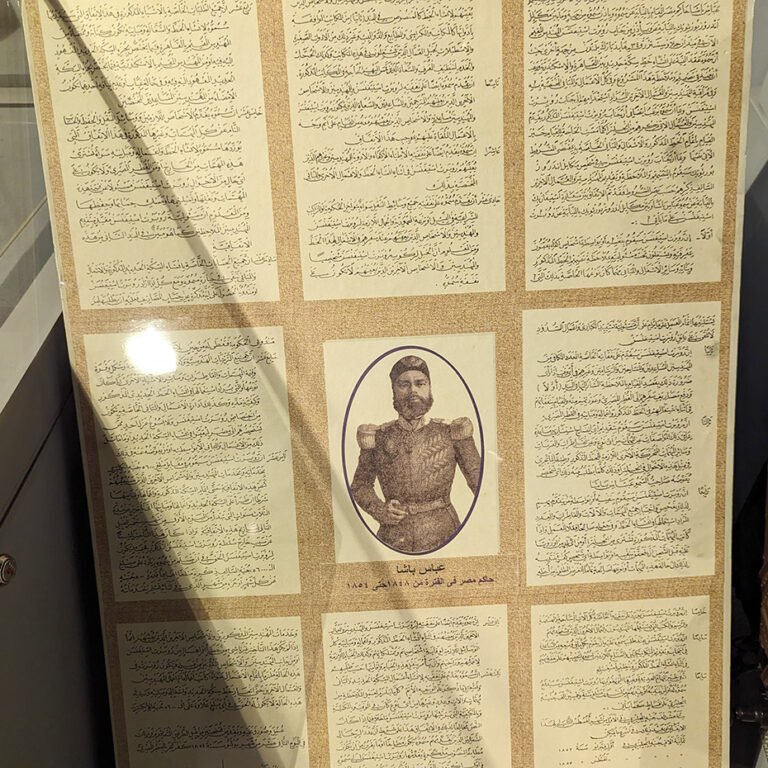
The establishment of railways in Egypt was a turning point in the history of infrastructure and transport in the region. It was an ambitious project that began with a contract signed in the early 1850s between Khedive Abbas I and the Briton Robert Stephenson, who was a civil engineer and locomotive designer. He was the only son of George Stephenson, known as the “Father of Railways,” who invented the modern steam locomotive. At that time, the Suez Canal had not been dug yet, and Egypt represented an important link between Europe and the Indian Ocean. The British saw railways as a means to facilitate their trade and military movement with India, while Khedive Abbas wanted to modernize his country and strengthen its economy. From here, the idea of establishing the first railway line in Africa and the Middle East was born, connecting Cairo and Alexandria to be a new artery for trade and transport within Egypt.
But agreeing on the project was not easy. A major dispute occurred between the Egyptian government and the British regarding the route of the railway line. The Egyptian government wanted the line to pass through the Nile Delta so that the cities and villages there and their local trade would benefit from the project, and also so that the Khedive could benefit personally and transport the crops of his own estates directly to markets. As for the British, they preferred a direct route through the Western Desert so that construction costs would be lower and the distance shorter, better serving their strategic interests. Negotiations continued between the two parties; the Egyptians were determined that the railway must serve their country first, while the British were focused on speed and efficiency for their colonial interest.
In the end, a compromise was reached, and they agreed that the line would pass on the edge of the Western Delta. Work on the project began in 1851, and by 1854, the first part connecting Alexandria to Kafr El-Zayat was completed. In 1856, the line was fully completed up to Cairo, making Egypt the first country in Africa and the Middle East to possess a functioning railway network. It was a historical moment, as people became able to move between the two cities in record time compared to traditional means of transport. This project was a big step in modernizing Egypt and connecting it to the outside world, but at the same time, it increased British influence over Egyptian infrastructure, making people wonder about the extent of Egypt’s independence in managing its large projects.
Despite the economic and commercial benefits of the railways, their political effects were far-reaching. They placed Egypt at the mercy of foreign interests, leading to increasing British influence in its economic and political affairs. Over the following years, European control escalated until it ended with the British occupation of Egypt in 1882. Thus, the railway line was not just an engineering achievement; it was a witness to the conflict between Egyptian ambition and foreign intervention. It was a story where modernity mixed with politics, drawing the features of the country’s future in a world controlled by the great powers.
References:
- Egypt and its Railways, Mohamed Amin Hassouna, Beit El Hekma Group for Cultural Industries, 2024.
- L’EGYPTE ET SES CHEMINS DE FER (Egypt and its railways), Lionel Wiener, 1932.
Baker