
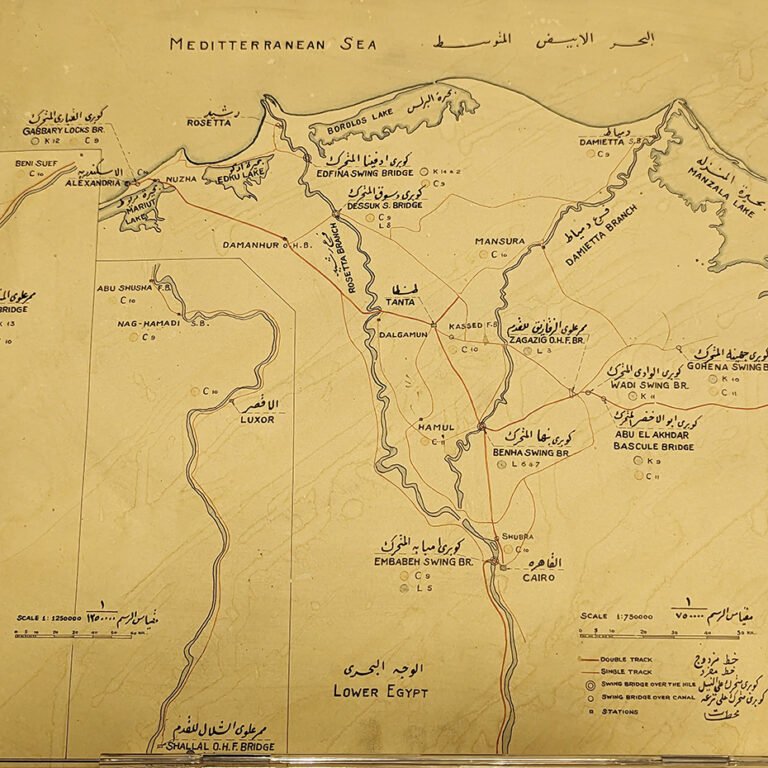
The relationship of kings with the railway was not just a royal vehicle or an important source of income; at one time, it was a central tool for shaping the geography of the homeland and for the ruler to gain legitimacy. This is explained by the difference between Abbas I and Abbas II and their views on the railway. If we look at the map before us, we will notice that one of the most important and farthest railway lines from the center in Cairo is the line connecting Alexandria and Matrouh, known as the Mariout line. This line specifically, just as the geography of Egypt in the Valley and Delta played a role in shaping the first railway lines, by the beginning of the 20th century, the railway contributed to reshaping Egyptian geography and its borders significantly.
The story begins with a land journey by Khedive Abbas Hilmi II on his horse in the lands located west of Alexandria up to Matrouh, which is now known as the North Coast. Abbas Hilmi noticed the enormous agricultural potential of the land there, which was a green paradise in Roman times and their favorite place for growing grapes. At that moment, the Khedive decided to buy a huge number of acres there and began reclaiming them using new irrigation methods. Over time, the Khedive’s interest in this part of Egypt increased, and he felt he could control it completely, especially after the British pressure on him in Cairo increased. Therefore, in 1899, he decided to start building a railway line connecting all these lands from Alexandria to Sollum.
This line was an embodiment of the idea of using economic development and reviving land as a means to gain legitimacy. This was because the British were trying to promote their occupation through the same idea, saying that the economic improvement in Egypt and the great investment opportunities during their era were the greatest proof of the legitimacy of their presence, because this would benefit the whole people even if they were individual investments. Khedive Abbas Hilmi was trying to beat them at their own game through the Mariout railway. The new line was not just a profitable economic project connecting his farms and properties and marketing his products, but it also contributed to reviving this region and its residents from the Awlad Ali Bedouins, bringing them closer to him and to Egypt. The Khedive told a reporter about a night he spent in his tent, where the sound of camels from passing caravans was heard all night; at that moment, he decided that if a railway were built between Alexandria, Benghazi, and Tripoli, it would change the face of the region, change the course of the caravans, and open new markets and cities.
Indeed, what he said came true. After west of Alexandria had been a neglected part of Egypt that not much was known about—to the point that Matrouh at that time was just a fishing village that only got crowded in the summer because of the arrival of Greek sponge fishermen—it turned after this line into an administrative center and then a city in its own right. This line was the private property of the Khedive and he spent on it from his own “Daira” (estate). Therefore, it was not state property even though he bought the necessary equipment from the Egyptian Railway Authority and Egyptian prisoners from the Public Works Department worked on it from the start. The Khedive was the first owner, and the British were not annoyed by this at first because they thought the line would fail and was just a toy to entertain the Khedive, with no political danger behind it.
The line started from Wardian west of Alexandria and passed through stations like El Max, Amreya, Mariout, and El Hammam, until it reached its last extension at Jarawla shortly before Matrouh. This line turned these stations into prosperous villages and centers, and there were four daily markets throughout the week in four of these centers along the line. The line contributed to transporting hundreds of thousands of tons of agricultural materials, especially barley and figs, in addition to sheep, which began to reach these markets even from distant places like Tripoli, thousands of kilometers away. An agreement was also signed with the Egyptian Railway Authority to exchange passengers at Wardian station, so the Bedouins in this region became able to travel to the Valley and Delta cities covered by the Egyptian railway network with an ease and speed that did not exist before.
At the same time, the train provided steady jobs with salaries for the Bedouins scattered in the region during the line’s construction operations. It also gradually turned them into settled farmers, especially in barley cultivation, after it became possible for them to sell their products easily. Therefore, as a result of this economic success, Abbas Hilmi II was able at that moment to extend his influence and legitimacy among these tribes in the area far from Cairo; consequently, their loyalty was primarily to him personally, not to the Egyptian government or the British, of course. He also consolidated the authority of the Egyptian state in all areas from Alexandria to Sollum, even without clear maps defining the borders between Egypt and Ottoman Libya at that time—borders that remain fixed to this day. Because of this, even at the beginning of the new millennium, the Bedouins in this region still mentioned the credit of Abbas Hilmi in spreading urbanization in the area.
Despite this economic and political success, Abbas Hilmi’s adventure ended dramatically. Due to a financial crisis he was going through, the Khedive decided to sell the line to an Italian company backed by the Italian government, which saw Ottoman Libya as its zone of influence and had already begun the war to occupy it in 1911. At that moment, the British revolted and tried to prevent the Khedive from completing the deal on the grounds that the line was built on Egyptian land and was being sold to a foreign country. Italy’s goal for the deal was to convince the Khedive to reduce support for the Senussi resisting them in Libya. In the end, the British decided to buy the line instead of the Italians, and its ownership moved to Egypt’s railways. It has continued its role until now as the most important transport line between the Nile Delta and Valley on one hand, and the western part of Egypt on the other, considered a witness to the role of the railway in shaping Egypt’s geography and history.
References:
Desert Borderland The Making of Modern Egypt and Libya Matthew H. Ellis