
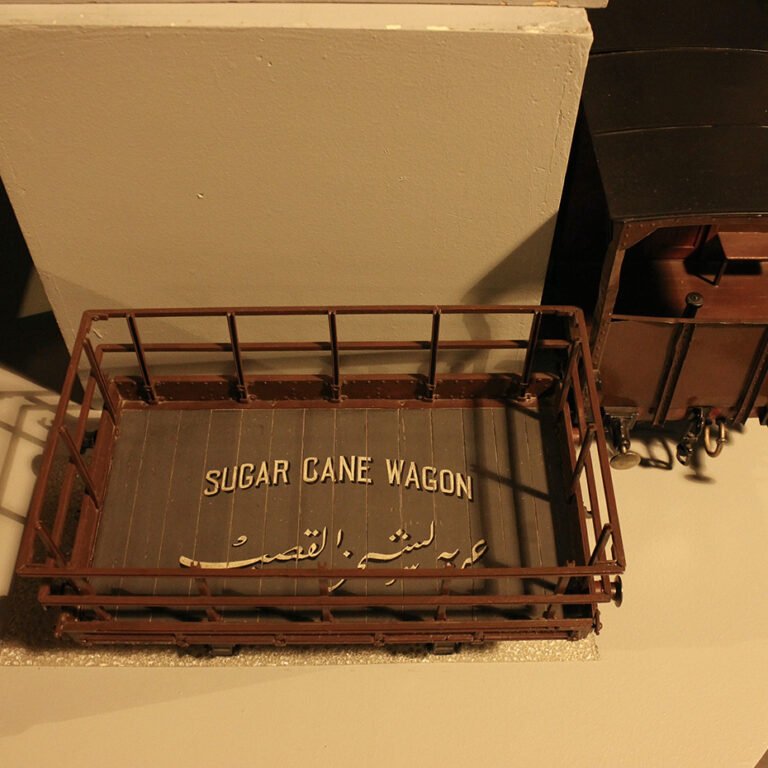
“Oh, father of the leaves, oh cane, we have a wedding set up”. Perhaps we have come across this song on one of the pages interested in history and memory in Egypt, because the images in the song tell the story of sugarcane, especially in Upper Egypt, and its role in shaping the history and geography of this area of our country. We will notice that one of the displayed carriages has written on it that it is dedicated to transporting the sugarcane crop; cane had and still has its own railways that operate only during the season.
The beginning of the cane railways was closely linked in Upper Egypt to the private property of major landowners, foremost among them the Khedive, who owned thousands of acres of land from Giza to Asyut. All these acres were fertile because of their location between Bahr Yusuf and the Ibrahimiyah Canal—the canal the Khedive established to provide permanent irrigation for summer crops in Upper Egypt, at the same time he extended the railway line from Bulaq al-Dakrur in Cairo to Minya.
This main line was the trunk from which the branches—the private sub-railways—sprouted. These small railways were not governmental like the main branch; they were the property of the Khedive and an integral part of his private cane farms, managed by the “Daira Saniya”. These railways were the backbone of sugarcane cultivation and export to make it profitable, especially given the Khedive’s heavy debts. This is because cane, once harvested, needs to be transported to refineries to be squeezed for sugar, all in less than 24 hours, otherwise it loses a large amount of its sugar content.
Therefore, the railway performed this task and saved the huge estates from needing pack animals. From that time, the cane refineries became the main station for the railway in these huge estates. One end of the railway would be at the farms to transport the cane, and the other end would extend to the Nile or the main railway to transport the sugar to markets or export ports.
Over time, the Khedivial cane farms became integrated colonies: we find housing for European engineers, factories, and warehouses, in addition to thousands of poor farmers. These farmers had lost their lands and lived on the bare minimum, stuck specifically in sugarcane cultivation rather than other crops that might satisfy their hunger, in estates designed to control their movement and ensure their continuity in this profitable investment for the Khedive.
The Khedive’s formation of these estates was originally part of a larger plan to serve his own trade. This plan included designing the main railway itself to suit the needs of his farms before anything else. On one hand, he decided to extend the main railway line to Asyut, not just because it was an important city, but also because it was the southern border of most of his farms in Upper Egypt, which exceeded fifty thousand acres. Thus, sugar could be transported to Cairo without trouble, and as soon as it arrived in Cairo, it was transported by a special direct line called the Khatatba line. It passed through the desert to Alexandria, connecting Bulaq al-Dakrur and Itay al-Barud without passing through the crowded Delta centers, foremost among them Tanta, in the same way the British suggested to Khedive Abbas.
Therefore, it is not an exaggeration to say that sugarcane and its railways largely shaped the geography of transport in Upper Egypt and the movement of people there. This formation first served the interests of the Khedive and the major landowners after him, not the farmers as happened in the Delta. However, the cane and its sugar did not succeed in saving the Khedive from the creditors. He was forced to mortgage his farms and their railways to take other loans, which eventually led to his deposition. To settle his debts, the ownership of these huge estates was transferred to major Egyptian and foreign landowners who benefited from the infrastructure like the railway and the estates themselves as a feudal system controlling destitute farmers and forcing them to work and extracting wealth from them, to be transported away on carriages with “Sugarcane” written on them.
References:
Unpublished PhD dissertation – Engineering Profit: Egyptian Railroads and the Unmaking of Prosperity 1847-1907, by Rana Baker