
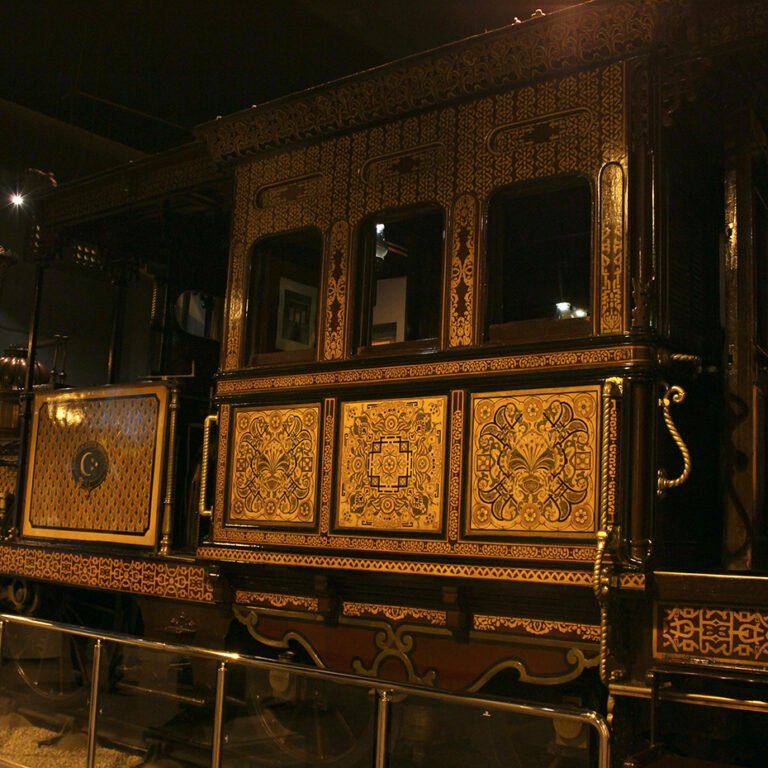
In the hall of the Railway Museum, on the ground floor, we will find before us the royal carriage. It is part of a wider family of royal carriages designed distinctively from the opening of the Canal until the middle of the 20th century to be the special carriage for the ruler of Egypt, whether Khedive or King.
This beautiful carriage was not just a decorated carriage; it was also specially designed from a mechanical standpoint. This is because its passenger was not just the ruler of Egypt, but the owner and the first passenger on the railway lines. From the first appearance of the railway, the train did not have fixed schedules, and this was for several reasons, chief among them the Khedive and his carriage. Since he was the first owner of the railway, his carriage did not wait for anyone to pass, and it was his and its right to pass at any time and in any place.
Iskandar Pasha Fahmi, who was one of the heads of the railway, tells a story about Khedive Said’s fondness for a certain pasta dish with curry at a hotel in Suez. He would suddenly decide to go there by train without any prior arrangements, and this caused one of his carriages to break down on one occasion due to the lack of coordination. This absolute priority in passing annoyed everyone, but the Europeans and the British among them considered it evidence of “Oriental Despotism” and the absence of any rationality. Despite this, the British who made the train did not think of advising the Khedive to commit to specific schedules and rules; on the contrary, they decided to give the Khedive an extra dose of his sense of leadership. They designed the train carriage so that it had a steering wheel and an engine, so the Khedive could practice his hobby of driving himself whenever he liked. In addition to this, the signal system was designed in a way that allowed the Khedive to stop or delay any other carriage and ensure priority for his royal carriage.
These designs crystallized Orientalist ideas among British engineers regarding the ruler’s absolute authority—ideas that appeared in a permanent mechanical design, whether in the carriage or the signal system. The result was that these practices increased, and with them, the impression among European passengers and in travellers’ handbooks that authoritarianism in the East was the primary reason for delaying their trains, not anything else.
References: