
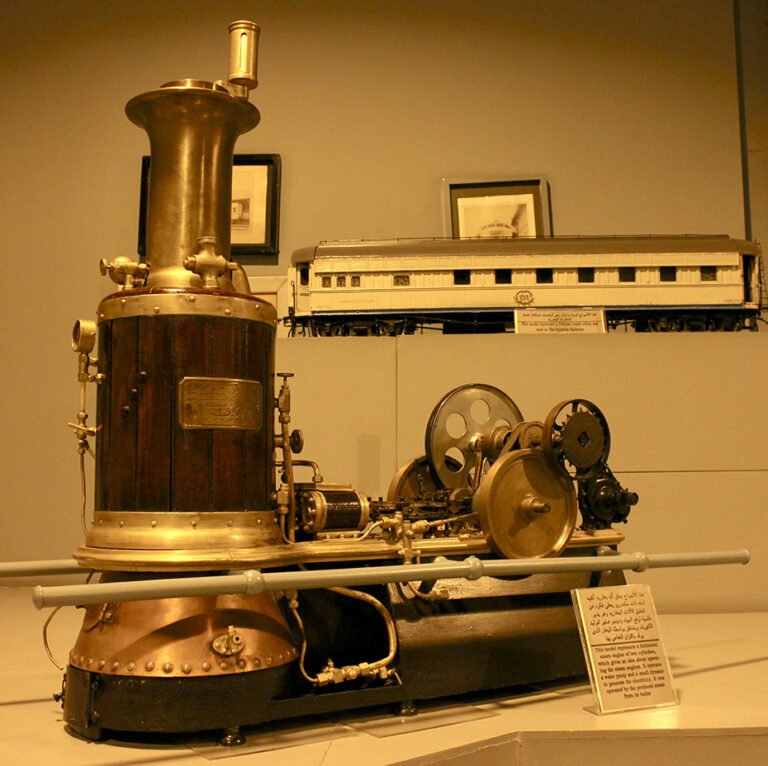
In the town of Devon, overlooking the English Channel, on a March day in the last quarter of the 18th century, Newcomen was trying to install his new machine to help his plumber friend with a difficult task: removing water from the copper mines that were widespread at the time. The machine converted the steam energy from boiling water into regular motion to lift water from the ground. Newcomen didn’t start his machine from scratch; he built it based on previous theories and inventions from a hundred years earlier regarding steam, its pressure, and converting it into usable motion. However, the exciting thing about his invention was its simplicity and regularity, because for the first time, steam could be converted into a constant, regular motion that could be utilized. Although this addition was simple, it was revolutionary and heralded the dawn of a new era called the Industrial Revolution. The primary goal of the invention at the time was to drain water from mines, and it required a large amount of coal. Therefore, there was no better place than Newcastle to apply this idea, as coal mines were clustered there, all needing water drainage, which until then had been the responsibility of horses. Once Newcomen invented his machine, the area turned into a forest of Newcomen engines capable of 12 cycles per minute to drain tons of water from these mines.
In the network of mines around Newcastle, which became the natural home for the steam engine, coal was widespread and cheaper than feeding a horse. These areas were largely the cradle of the Industrial Revolution, not just because of the coal, but because they were the first stage for testing the new steam engine and the place where steam locomotives would later work. However, until that moment, they were not as important as the forest regions of Europe, from which the most important material of that era—wood—came. Before iron and coal, wood was the source of energy and movement and the primary construction material for ships, houses, and other uses. This primary reliance on wood was the main reason for its depletion, thus accelerating the Industrial Revolution due to the acute shortage of wood. But in that era, wood, which is a natural, non-manufactured material, gave an organic and real feel to the relationship between man and his surroundings. Wood was the fuel, alongside water and wind, which were the basics for generating kinetic energy. This feature would gradually disappear as energy and materials shifted toward coal and iron, and man’s relationship with nature completely changed as a result.
Returning to Newcastle and its mines, the steam engine’s first task was to drain water, and its high coal consumption wasn’t a problem in that area. But over time, another use for coal appeared in textile factories; these factories were built next to water channels to use water power to move spindles and looms. The problem was that water movement is essentially seasonal. So, the idea came for the engine to lift the used water so it could be reused without waiting for new rainfall. The use of the engine remained largely confined to these simple tasks for one main reason: the only motion it could perform was vertical. However, this would suddenly change with a name the world would later know as one of the most important inventors in history: James Watt.
James Watt worked in the field of steam power, and his company sold the Newcomen engine to mine owners. Over time, the market became saturated, and there wasn’t much demand for these engines. His company asked him to think of new uses for the engine, and the result was his development of the original engine so it could produce circular motion. He also reduced coal consumption, though it was still a large, difficult-to-move engine. Producing regular circular motion from energy that didn’t fundamentally depend on nature—like wind or water—was considered a true revolution. For the first time, man transcended nature after having followed it and tried to align with it. Before this time, a boat couldn’t be faster than the water beneath it or move against the surrounding wind, but that changed forever. From then on, man would overcome nature in various ways, and steam would enable him to fold the earth and time, or in the words of people at that stage: “the disappearance of the boundaries of time and place”.
This invention sparked the Industrial Revolution, and steam fever swept through all industries, most notably textiles. Regular circular motion led to a leap in production and a great development in the equipment used, as well as the workers. Craftsmanship in the old sense ended, and the specialized division of workers on machines appeared. As a result of all this, coal was the most important driver of the entire scene, but its transport still relied heavily on horse-drawn carriages. This continued until a third inventor, Evans, came along and condensed the steam engine and significantly improved its performance, then reduced its size. For the first time, it became possible to transport it easily on a carriage and use it for transportation. The natural home for this invention was the network of coal mines in Newcastle. Due to the abundance of coal, the need for it, and the development of the engine, the first railway network was created to connect the mines to the nearby river so coal could be transported quickly. Steam power was used for the first time to transport goods and coal, and consequently, people.
Transportation in Britain at that time was advanced compared to the rest of Europe. Even before the railway, it relied mainly on horse-drawn carriages traveling at 10 miles per hour on regular, paved roads. However, nature—whether in the limits of the horses or the terrain and distance of the land—was the primary determinant of the journey. The transition to steam railways wasn’t as smooth or logical as we imagine now; chance also played a role. The Napoleonic Wars at the beginning of the century affected the availability of horses, making them expensive and hard to buy. More importantly, the price of horse feed—which was corn—rose sharply due to the imposition of customs duties, primarily to protect agricultural landowners and their interests. Consequently, steam and available coal were the most suitable options for transport at that moment, and from here, the railway began its journey in changing the shape of travel in the world.
People were divided in their reaction to this radical change in their way of life. Horse-drawn carriages represented to some a connection with nature and a feeling of the journey and its details, while the train was considered the cancellation of that entire intimate relationship. On the other hand, some saw the railways as a golden opportunity for transport, trade, and traveling the farthest distances, in addition to representing regularity, consistency, and endurance, unlike animal power. Over time, the conflict was settled completely in favor of the railway, and traveling by horse-drawn carriage became a hobby for the rich, leaving the train to sit alone on the throne of transport until other competitors appeared a century later.
References:
Wolfgang Schivelbusch – The Railway Journey_ The Industrialization of Time and Space in the Nineteenth Century-University of California Press (2014