
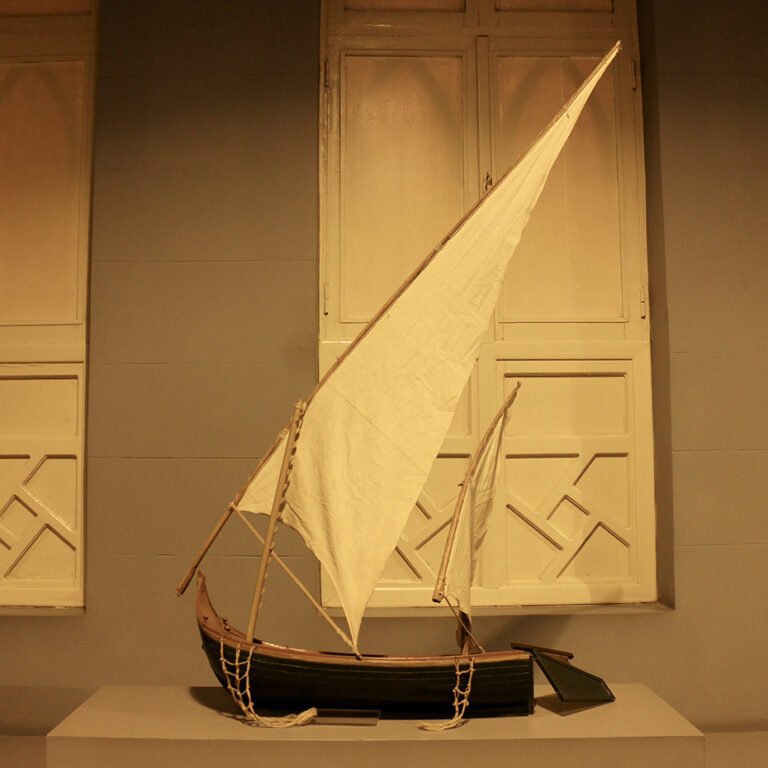
It might seem a bit strange to find a simple sailboat in a railway museum that symbolizes modernity and progress, but what is even stranger is that the location of the museum itself, along with the railway station and the Al-Fath Mosque in front of it, was once one of the most important river ports in Cairo. It was the Port of Al-Maqis, which represented the historical meeting point of the Nile with Cairo’s borders before the river receded to its current position and the river port moved to Bulaq—a neighborhood that also houses the railway workshops and worker housing. This historical coincidence reflects the fundamental change in Egypt’s transportation movement from the river to the land.
The Nile has long been known as the secret of existence in Egypt because of drinking and agriculture, but it was also the artery that connected Egypt’s various parts and linked it to the outside world. Today, it might be hard to imagine river transport, especially since its presence in Cairo now is mostly limited to a few tourist and entertainment activities. However, about two centuries ago, the Nile and the ships on its surface were almost the cornerstone of all of Egypt. If we look at any map, we will find various cities on the banks of the Nile, and each city’s importance varied according to its port and its historical significance.
Cities like Qus and Esna were among the most important hubs in Upper Egypt because they connected the Red Sea and its trade coming from the Indian Ocean to all parts of Egypt, sending vital goods like spices and coffee to Asia Minor and Europe. The ports in Cairo—specifically the Bulaq port in the north and the Misr port in the south—were major local and international trade centers and played a big role in the development of these areas compared to others. River ports are now a thing of the past, but back then, they were independent entities divided into sections called “Mawarid” (singular “Mawrada”), named after the types of goods transported, such as the rice port or the wheat port, also known as the Grain Coast. They were also divided by destination, such as the “Mawrada al-Risala,” which sent necessary grains to the Two Holy Mosques, especially during the Hajj season. Even the small harbors on both banks of the Nile used for passenger crossings had their own systems and were called “Al-Maadi,” the most famous being the “Maadi al-Khabiri” near the upscale Maadi district. These harbors also had their own management systems and economies built around them.
These areas along the Nile were not alone; there was also a complex system of boats that evolved over centuries, making the river transport economy in Egypt as interconnected as the maritime shipping economy is today.
Riverboats were as diverse as the banks they sailed along. There were massive boats over a hundred meters long that carried soldiers and equipment during wars, as well as pilgrims to their holy destinations. These were surrounded by smaller boats that served them and carried supplies. There were also very small boats called “Falayek” that transported residents of the Valley and Delta through canals and small branches, especially when Nile water was scarce due to the lack of a flood. This variety in size was matched by a variety in the boats’ operating environments. Some boats were for the Nile only, while others could sail at sea, transporting supplies through the Damietta and Rosetta outlets between the sea and the river. Because of this diversity, boats gained vital roles like transporting goods and travelers on regular lines, such as the river transport line between Damietta and Cairo every Monday and Thursday. Boats also had social functions, like decorated boats for celebrations, which became symbols of power and influence, especially during the Mamluk and Ottoman eras.
Despite this diversity, the boats followed a nearly unified system in their work and relationship with the Nile. Boats heading north relied on the Nile’s flow from the highlands to the valley, while boats heading south always waited for the wind to carry them against the current. Water and wind energy, and their conditions, were the primary controllers of boat movement. If the winds were strong or the water rush increased, boats would sink, as happened during floods. If water was scarce or the wind was absent, the boats would stop, no matter how much people needed to move.
Egyptian sailors understood this harmonious relationship with nature thousands of years ago, and these systems were inherited by generations of sailors and boat workers. The human element, their understanding, and their muscles, combined with the power of nature, were the main drivers of this huge river fleet. Each boat had a crew of captains, sailors, and navigators, each with a specific job. These boatmen organized themselves into larger, more complex guilds, forming a professional and social class with its own language and customs, which remains part of folk memory to this day.
The economy linked to river transport was very complex and advanced. Each boat represented an independent company, no matter how small, and ownership was divided into 24 carats, branched out among various people and institutions. The view of boat owners from the Islamic era until the time of Muhammad Ali reflects the nature of the elites during that period and the idea of venture capital in a highly profitable activity like river transport. Entire worlds were built around this activity, both in reality—like the neighborhoods of Bulaq and Athar al-Nabi—and virtually, through the idea of ownership, commercial contracts, and the social classes that formed around it. The first group to own shares in many boats were the captains and navigators themselves; this system ensured they were treated as partners rather than just workers or hired hands, making them keen on profit and boat maintenance.
Merchants also participated in these ownership processes because their trade relied primarily on riverboats, making boat ownership important and profitable regardless of the cost. So far, it seems perfectly logical that the operators and direct stakeholders were the main owners, but in reality, many other people participated in this vital economic activity.
For example, religious scholars and Sharia judges in major port cities like Damietta and Rosetta were among the most important owners and shareholders of riverboats. It reached the point where certain Sufi orders monopolized specific boat lines and ferries, not allowing anyone to compete with them because their other activities relied heavily on this source of income.
Additionally, women, Christians, and Arab tribes participated in the management and ownership of many ships and boats, giving us a picture of a broader base of ownership that was not just limited to those in power.
Despite this, those with military power had a large share of boat ownership, specifically the Ottoman military group known as the “Azban,” who were responsible for securing river transport. Initially, members of the military groups were not allowed to trade or participate in order to maintain their integrity, but over time, as the Ottoman state weakened, things got out of control. Trading in boats became more common among all ranks, from soldiers to princes. It reached the point where the “Amin al-Bahrayn,” who was primarily tasked with maintaining security and collecting fees on boats, became the largest boat owner. He had his own fleet that was exempt from all fees and taxes imposed on other boats, which became a custom for a long time until the conditions and importance of this military group in maintaining security changed, which in turn played a major role in determining the economic feasibility of these boats.
This story highlights the importance of security along the banks of the Nile and the regulation of boat movement, the distribution of influence zones, and the sharing of the spoils of the profitable river transport industry. Attacks occurred along the Nile, but their primary goal wasn’t just looting; they were simply meant to determine the dominant power in a location and, therefore, who should be paid taxes and tolls.
Therefore, when the Ottomans entered Egypt, they decided to concentrate all power in one place—Cairo—and put it under the control of a single group, the “Azban,” to be primarily responsible for securing the Nile and collecting fees, with a complementary role for local regional rulers. This system worked efficiently for a century or more, but as the central government in Cairo weakened, other powers began to appear along the Nile from the Valley to the Delta, sharing influence and collecting fees in those areas. The state responded by asking rulers and farmers to protect passing ships in their areas, giving them some privileges, like providing a ship for each village to help with protection and exempting villages from taxes if their farmers were killed while defending the ships.
This system sounds decentralized and effective in theory, but in practice, farmers had no incentive to die defending ships, especially with strong attacks from groups like the Bedouins and others. In fact, farmers would sometimes abandon their villages entirely during times unsuitable for farming. This failure to secure the Nile continued in the 17th and 18th centuries until the state and the Pashas in Cairo decided to share influence and make deals with the same groups that were attacking the ships, paying them money to “secure” the ships. This allowed groups of Arab tribes along the Delta to become part of the state’s power after they had been its enemies in those areas.
These deals ended in one way or another during the era of Muhammad Ali, with the return of a stronger central state and its tight control over Nile security in the 19th century. This complete cycle from centralization to decentralization and back to centralization shows the close relationship between the existence of a strong central state in Egypt and the idea of the Nile—how it works, from distributing water to the regions to securing its navigational path. The quest to establish strong centralization has been the key to controlling Egypt since ancient times.
The 19th century arrived in Egypt, and the Nile and its boats sat on the throne of internal transport and trade. Their importance increased with projects like the Mahmoudiyah Canal connecting the Delta to Alexandria, and the Ibrahimiyah Canal in Middle Egypt. But despite this, by the end of that century, the star of traditional river transport began to fade. The main reason wasn’t just the appearance of the railway with its speed and capacity, because merchants simply used both together to transport their goods by the cheapest means possible. Proof of this is the founding of the city of Kafr El-Dawar on the banks of the Nile, as the city sat on both the Nile and the railway line between Cairo and Alexandria. Cotton was transported to it by rail to be spun, and then moved by boat to Alexandria to save on railway costs. This city became a stronghold for spinning and weaving.
Because of this, the British, after colonization, decided to change the nature of the Nile as a lifeline and transport artery available to everyone. They imposed heavy fees on boats passing through it to make it more economically viable to transport goods via the railway. At the same time, they invested a lot of money in creating wide agricultural roads between cities and villages in the Delta as a way to transport agricultural products directly to sea ports for export. This preference for the railway and land roads, along with technological development and the lack of interest in river transport, pushed river transport away from the throne of internal transport in Egypt in favor of the iron machine that came from afar, and everything that accompanied it in terms of the change in man’s relationship with nature, time, and the clock.
References:
1- Nile Navigation in Ottoman Egypt – Abdul Hamid Hamed Suleiman
2- Unpublished PhD Dissertation – Engineering Profit: Egyptian Railroads and the Unmaking of Prosperity 1847-1907 – Rana Baker
3- The Scales of Public Utility: Agricultural Roads and State Space in the Era of the British Occupation – Aaron George Jakes