
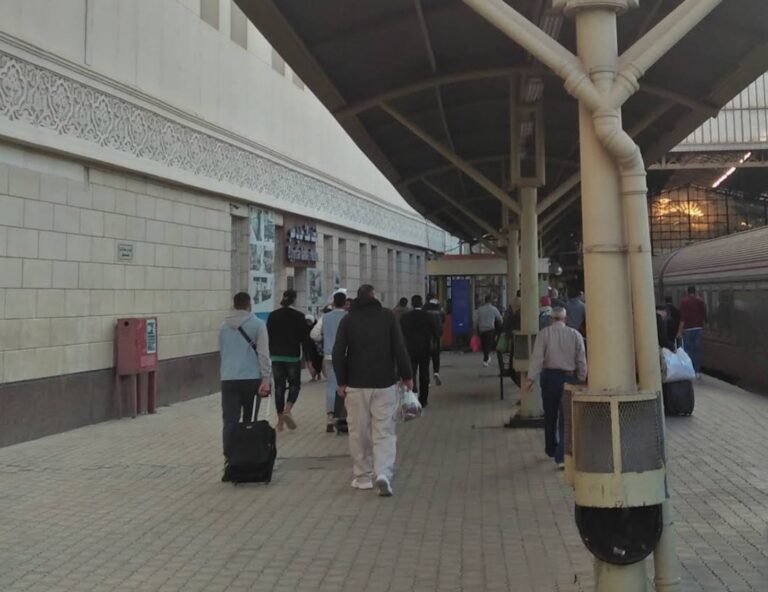
Ramses Station or Bab al-Hadid is located in the heart of Cairo now, and the station and its tracks divide the city into important neighborhoods, like Shobra and Rod al-Farag on one side, and Al-Daher, Al-Ataba, and Downtown on the other. In the same station and the square around it, there is an imagined point as if it’s the center of a circle for all transport within Greater Cairo or from it to all provinces north and south. In it, we will hear calls like “Bulaq” or “Sayyida Aisha,” and also calls like “Alexandria,” or “Mansoura,” or even “Qena”. If we look around us, we will find all types of transport in one place, from the metro, bus, microbus, and taxi, to the motorcycle, passing through the tram that existed in the past—all this next to the station and the train in its center. All these lines start from Ramses and set off for almost every inch of Egypt, not just in Cairo. Therefore, this square receives and sees off daily almost millions of people and goods coming from every direction and going in every direction. The vitality and great movement in this place seem logical especially because it’s in the city center now. But in reality, the situation was not like this in the beginning; because the area where the station was built was considered in the past the northern edge of historic Cairo, and it was not heavily populated until the beginnings of the 19th century. The presence of the station in this remote spot was not an exception; rather, it was the custom for train stations to be built on the outskirts because they needed vast spaces for use and storage, and this would have been difficult to provide in the middle of any old city without massive demolitions or paying large compensations to landowners.
Also, the stations created an industrial state around the place due to the presence of workers, workshops, and waste, and this makes living around the station unattractive, whether for stability or just as a passing hotel.
Even though the station was built on the edge of the city, it quickly affected the shape of the city and its center significantly. As soon as we exit the station, we will find before us large streets connecting to squares like Tahrir, Al-Ataba, and Al-Abbasia. These large, wide streets were not common in previous eras, neither in Egypt nor in Europe. Rather, these streets were born from the womb of a massive modernization process that happened in the middle of the 19th century. At first glance, these streets will look like a straight and extended railway line connecting two points in the shortest possible way, and this is perhaps what occurred to the urban planner “Haussmann” as he reshaped the new Paris, from which Cairo inspired these urban planning forms.
Perhaps these streets had a military goal primarily, to facilitate the quick entry of the army and its control over the city, but the second important goal was to facilitate the large traffic movement with the beginning of the railway era. The arrival of the railway from Alexandria to Cairo in the late 1850s was followed years later by the establishment of the Ismailia neighborhood or Downtown with its known streets in the 1860s. The number of railway passengers, for example, rose from 2 million at the end of Ismail’s era until it reached 30 million in the 1919 revolution. The railway, and in its heart Ramses Station, carried millions of tons of goods around Egypt at the beginning of the 20th century. this enormous amount of people and goods was not common before, and this made the main train station in any city, especially the capital, surrounded by a huge network of transport means and wide roads to facilitate the passage of what the trains were carrying.
Near the station, there were three important streets: Shobra Street, Sahafa Street, and Emad El-Deen Street. These pivotal streets affected and were affected by their presence next to the railway. Starting with Shobra Street and the Shobra neighborhood, which were agricultural lands before, and over time it became a working-class neighborhood par excellence due to the presence of workshops and housing for railway and tram workers in it. The intensive presence of workers in this area made it a stronghold for the labor movement, especially during revolutions and uprisings throughout the 20th century. This also contributed to the spread of labor activism and the ideas linked to it throughout Egypt through railway workers and employees.
The second street is Sahafa (Press) Street, in which there is a group of important press institutions, led by Al-Ahram. These institutions relied on railways to distribute their cultural products, most importantly newspapers. For example, the Egyptian Post used to distribute about 51 million letters and parcels annually before World War I, at least a third of which were newspapers and journals. This blending of the press and the railways and the existence of Sahafa Street next to Ramses Station helped significantly in the cultural hegemony of the capital over the rest of the provinces.
The third street near the station is Emad El-Deen Street, which in the first half of the 20th century was an integrated institution for producing culture, music, and art in all its forms. On one hand, its proximity to the station made it a primary destination for everyone coming to the capital for the purpose of exploration or entertainment or entering its theaters. On the other hand, the songs and arts produced from this area and their popularity and recording on discs were spreading and being sold in all parts of Egypt thanks to their distribution through the railway.
These streets and their close relationship with Ramses Station and its trains contributed to spreading ideas, culture, and arts from Cairo to all parts of Egypt, and made the Cairene dialect the primary Egyptian dialect. Therefore, the railway network in Egypt is like the spokes of a bicycle wheel; all roads meet at the Cairo hub, in the middle of which is Ramses Station, and from there they go out to every inch of Egypt’s land.
References:
Ordinary Egyptians: Creating the Modern Nation Through Popular Culture Book by Ziad Fahmy