
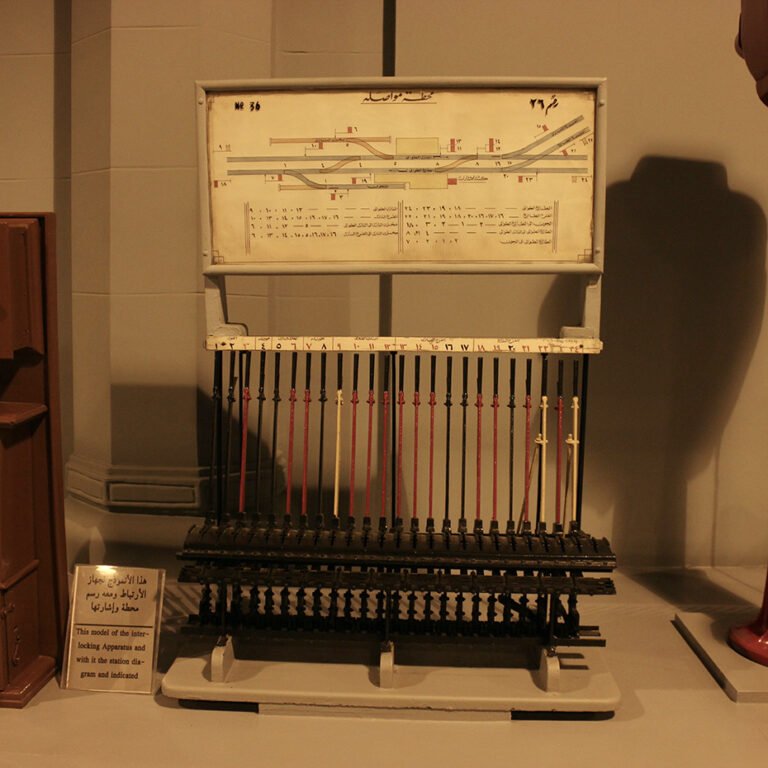
One day in April 1882, a railway signal employee was sitting in his booth on the train path between Alexandria and Tanta. His role was to record train movements and operate signals so that no accidents occurred between them if they met on the same tracks at the same time. That day, he was attacked by a group of gang members who had firearms, sticks, and stones. Although the employee resisted them at first, after they beat him and fired shots in the air to threaten him, he was forced to follow their demand, which was simply to change the signal for the train coming in a little while. Merely changing the signal to red was all the gang members wanted to rob the train and then disappear completely, after locking the employee in his booth for hours until his colleagues discovered the matter during the shift change.
This incident was part of larger events that occurred in the last quarter of the 19th century—thefts on railway lines through the manipulation of technology, most importantly the signal system. Signaling systems were already operating from the first moment of the railway’s launch, with the goal of sending instructions to the train driver, especially if there was another train to avoid or any other circumstances.
But alongside the use of this technology to organize trains, there was another use for it—not by the train operators or its passengers, but at the hands of gangs specialized in stealing containers from trains. These gangs appeared at that time as part of a larger movement in Egypt that included groups of Bedouins and destitute farmers, and even junior police officers.
Despite the boom achieved by the railway in easing movement, speeding up trade, and contributing to the accumulation of wealth for some through exporting our cotton to Lancashire factories in England, a large part of the Egyptian people in that era did not reap any fruit from this economic leap; on the contrary, their suffering increased. Starting in 1876, when the Debt Commission established by the occupation took over Egyptian financial affairs, economic conditions for broad sectors of the people became distressed. This was due to the focus on paying off Egypt’s debts and their interest instead of investing in infrastructure or providing services to the people. Therefore, marginalized groups decided to redistribute wealth themselves using other methods, the main one being the theft of railway containers, after the failure of the Orabi Revolution.
Over time, it became clear that this theft was not random or simple; it required planning, organized effort, and awareness of railway technology. The main obstacle facing the gangs was trying to slow the train down to a suitable speed that would make it easy to board and rob. This couldn’t happen without their intervention except before or after stations for passengers to get off or on. From here, these gangs resorted to solutions, some primitive, like putting stones in the train’s path to force it to stop, or advanced methods like manipulating signals. This was done by taking control of signal stations and changing the green signal to red to stop the train (like our incident here), or even hiding the original signal and hanging a red light in its place—a trick that experienced drivers uncovered, but it succeeded and fooled some of them many other times.
Faced with the expertise shown by these marginal groups in theft, the government and the British occupation decided to change the entire signal system in the railway and replace it with a newer one. This new system, known as the Westinghouse system, allowed the employee at the main station to record train movement and control signals remotely, without having to be in isolated areas. In truth, railway technology was behind the upheaval of the lives of these marginalized people, and perhaps marginalized them further, but they nevertheless managed to affect it without necessarily being aware of it. In the end, all the marginal groups wanted was a part of the wealth produced by technology, but they were not interested in radically changing the system, benefiting from it, nor did they even disrupt trains or cut railway lines as happened later in the 1919 revolution for much larger goals.
References:
Usurpers of Technology: Train Robbery and Theft in Egypt, 1876–1904