
King Fuad I had a great desire to collect statistics, exhibits, and photos to create a detailed history reflecting the development that occurred in railways, telegraphs, and telephones in Egypt. In a world full of fast trains and new ideas, there was an idea that started in 1885 when a group of railway men from all over Europe (except England) met in the city of Brussels to celebrate fifty years since the establishment of the first railway line in Europe. This meeting was very special, and from it a new association was born called the “International Commission of the Railway Congress,” and they chose the city of Brussels as its headquarters. The goal of this association was to help in the development of railways by holding international congresses in capitals and major cities, so that railway experts from all over the world could gather and exchange ideas and experiences regarding how to improve them and make them faster, better, and safer.
In 1933, it was Cairo’s turn to host the 12th session of the International Railway Congress. So the King’s desire to collect exhibits met with the preparations for the congress, and the Railway Board of Directors decided in January 1932 to begin establishing a museum special for railways, telegraphs, and telephones in Egypt, with the aim of opening it at the International Railway Congress in January 1933.
The process of building the museum buildings began on October 26, 1932, and it was a wing added to the main station buildings in Ramses, designed in a way that aligns with the architectural style of the rest of the buildings. All furniture was painted green, which is the state’s color, and stainless steel was used in many parts of the museum. The number of exhibits and models reached about 600, along with many technical data and statistics. The museum team seized the opportunity to borrow some valuable models from various railways around the world, to compare the situation of Egyptian railways with their global counterparts.
The Railway Museum remained open for visits until it was closed in 2010 for the purpose of developing it, and it was reopened to the public in March 2016.
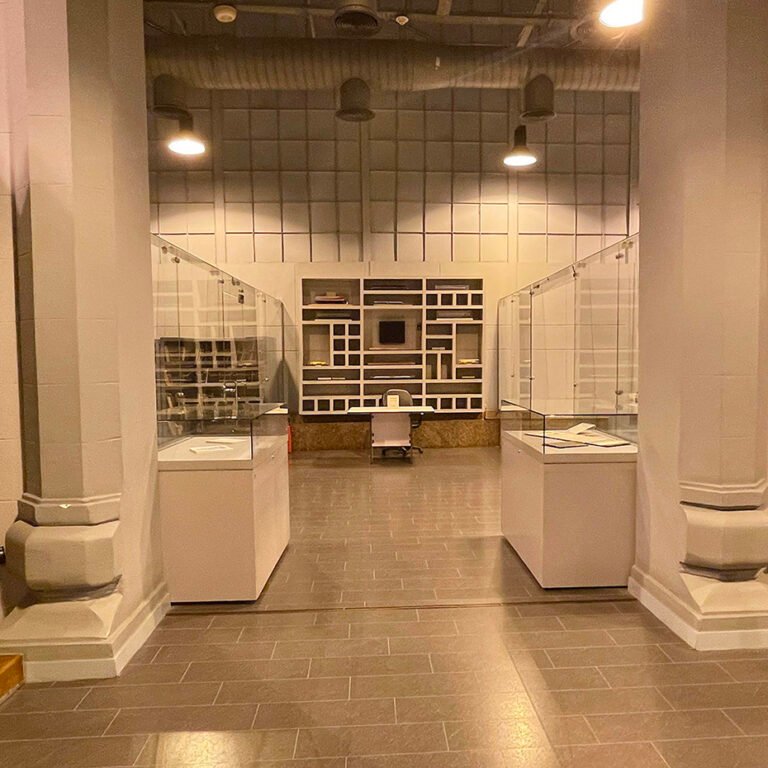
Now the museum includes, beside its exhibits, a library open for visits and browsing. This library contains a large number of volumes and historical, technical, and statistical books about transport and railways in Egypt; it also contains a collection of general books and novels. This library is considered a very rich source for researchers, historians, and amateurs who want to explore the technical, cultural, and historical aspects of railways in Egypt.
In the library, we will find a collection of historical publications including historical records related to the development of the railway system, periodic magazines, annual reports, and publications from the Egyptian National Railways and related institutions, which show the developments, challenges, and milestones in the railway sector. We will also find plans and technical drawings of important railway stations, trains, and steam engines, especially those dating back to the colonial era and the early 20th century. There is also a collection of books and magazines covering various aspects of railway history, engineering, economy, and transport policies, with a focus on the Egyptian and regional context.
Among the most important resources available in the library are the historical issues of the Egypt Railway Magazine from 1930. There are also issues of “Al-Waqa’i’ al-Misriyya” (The Egyptian Gazette) and a collection of historical budgets for Egypt’s railways.
References:
- The Museum: Its Establishment and General Description, Egyptian Government Railways Magazine, Mr. Slaughter, Year 2, Issue 1, January 1933.
- Egyptian Railways website, https://www.enr.gov.eg/Ar/Album.aspx?ID=1