
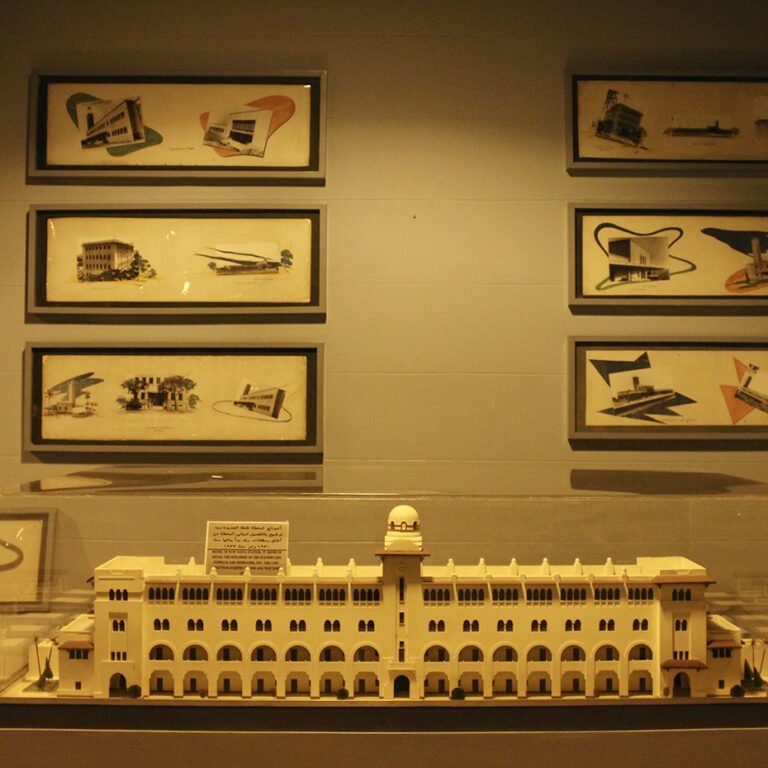
On one of the spring evenings in March 1854, the British engineer Henry Swinburne was still sitting in his office, even though the workday had ended hours ago. On this evening, which was specifically March 8, Henry was working on the design of one of the most important railway stations, the contract for which was signed days ago, until it got dark, to the point that he was no longer able to see his pencil, as he wrote in his diaries. This city was not known to Europeans, nor was it a port for exporting cotton like Alexandria, or even the capital of government in Cairo, but it was for a city in the heart of the Delta that was not known outside Egypt before. This city is Tanta.
Months before this moment, the conflict between the Khedive and the British company regarding the route of the railway in Egypt, and whether it would pass through Tanta at all, had not been settled. This was because the British—whether it was the government or the company implementing the train—preferred that the road from Alexandria to Cairo be outside the Delta, in the desert, to transport British passengers directly from their ships in Alexandria to the Cairo station, before transporting them to Suez once again directly, on the route known as the Land Route to India. But despite this, the Khedive and his “Diwan” (cabinet) decided that the train should pass through the Delta, not the desert, and that its priority should be transporting Egyptians, especially farmers, to their markets and destinations, even if this increased the time the European traveler spends on his land journey to India. This decision of the Khedive was built on the realization that Egyptians—especially farmers and their goods—would be the primary source of income for the train, and without them, the train would not work well or achieve income; in fact, it might stop completely, as happened later with the Cairo-Suez train which relied only on Europeans.
As a result of this decision, it was logical that the central node in the new railway would be the city that hosts the most important “Moulid” (festival) in Egypt and has the oldest market in the Delta. Tanta’s location between Cairo and Alexandria, in addition to its guardian saint, Sayyid al-Badawi, made it the new center of the Delta, surpassing older and larger cities like Mansoura or industrial centers like Mahalla. For example, the festival that was visited before the train by about 150,000 people saw the number of its visitors in the late 19th century after the entry of the train reach more than half a million people.
The railway not only speeded up the journey to Tanta and its festival, but also reduced its cost and its load, which was large and needed at least two days, whether by land or river. Therefore, the station was built very close to the Sayyid al-Badawi mosque, and the two relied on each other; the festival was not just a religious event related to a Sufi pole, but it was also an economic event par excellence, and there was no contradiction between all of this. The farmer coming from the villages of Sharqia and Daqahlia, and the merchant coming from Damietta, combined prayer and “Dhikr” (remembrance) with trade, exchanging goods, and paying off agricultural debts and other worldly benefits. It was a festival and a market at the same time, bringing together spiritual and material needs in one place and one moment, which made it difficult for some Western travelers and historians to understand later, due to their perception that economy and religion are a contradictory and separate duality that does not meet. But the truth is that Tanta and its festival were the living embodiment of the combination of these two activities.
Usually, the Tanta station—which was designed by Henry Swinburne but he did not live long enough to see it—was crowded all the time, but during the festival time, it used to be “charged,” to use Ali Mubarak’s description of it. From everywhere in the Delta at that time of the Hijri year, farmers would come to Tanta with their various crops of grains like wheat, barley, and others, which were more important and profitable than cotton for Egyptians and their interests. During the festival, crops were not sold for money, but were to pay off the previous year’s debts and also to buy what they needed for the new agricultural cycle. Therefore, the agricultural cycle and the Hijri year were the important time for the farmer, and for him too, grains were the most important crop, not cotton, and finally, Tanta and its festival was the place he headed to, not other cities linked to the global export economy based on cotton and its cities like Alexandria and Manchester. Therefore, over time, Tanta became linked to all the Delta cities like Mansoura, Zagazig, Damietta, and Rosetta, so it was the station where crops acquired new value and became profitable for the farmer who grew them. Also, no train goes from Cairo to Alexandria or vice versa without passing through it, and thus all roads lead to Tanta.
References:
Unpublished PhD dissertation – Engineering Profit: Egyptian Railroads and the Unmaking of Prosperity 1847-1907, Rana Baker